
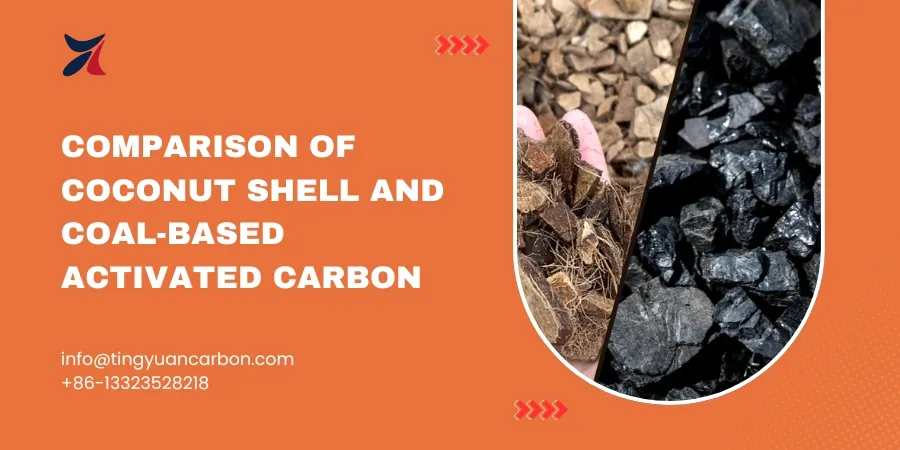
In fields such as water treatment, air purification, gold recovery, and the food industry, activated carbon is a highly important adsorption material. Depending on the raw material used, activated carbon can be classified into several types. Among them, coconut shell activated carbon and coal-based activated carbon are the two most common and widely used products on the market.
This article will explain the differences between these two types of activated carbon in detail to help you choose the most suitable product for your application.
Differences in Raw Materials
The most fundamental difference between coconut shell activated carbon and coal-based activated carbon lies in the raw materials used.
Coconut Shell Activated Carbon
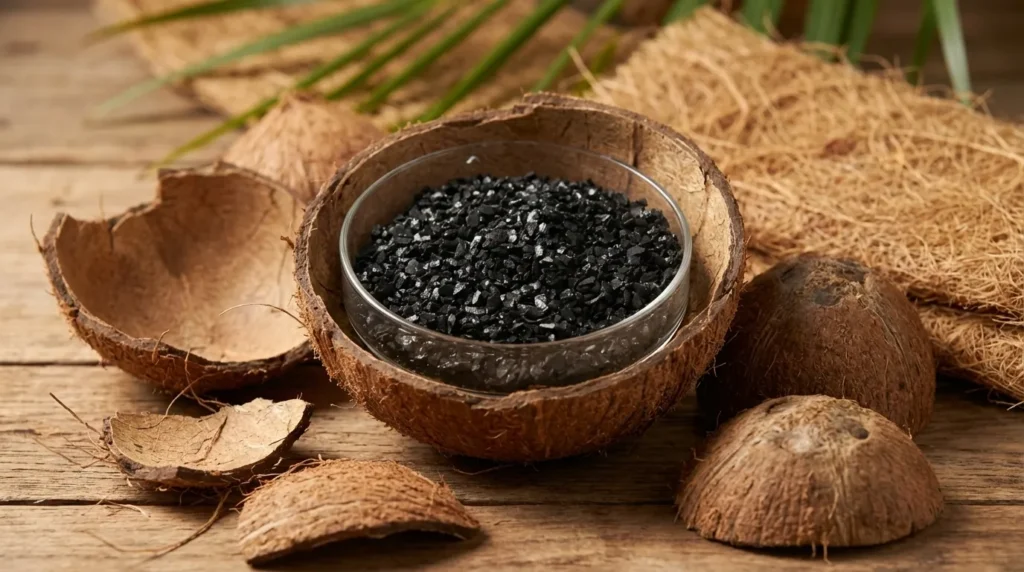
Coconut shell activated carbon is made from natural coconut shells through carbonization and high-temperature activation processes. Because coconut shells have a dense structure, the resulting activated carbon has high mechanical strength and a well-developed microporous structure.
Main characteristics:
- Natural and renewable raw material
- Low ash content
- Well-developed microporous structure
- Stable adsorption performance
Coal-Based Activated Carbon
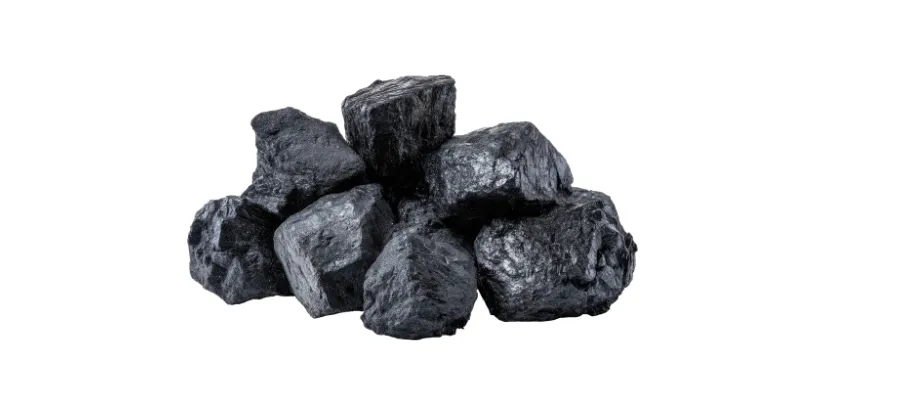
Coal-based activated carbon is produced from bituminous coal or anthracite. The coal is crushed, formed, and then activated to produce the final product. Compared with coconut shell carbon, coal-based activated carbon generally has a more diverse pore structure, containing both micropores and a larger number of mesopores.
Main characteristics:
- Stable raw material supply
- Relatively lower cost
- Wide pore size distribution
- Suitable for large-scale industrial applications
Differences in Pore Structure
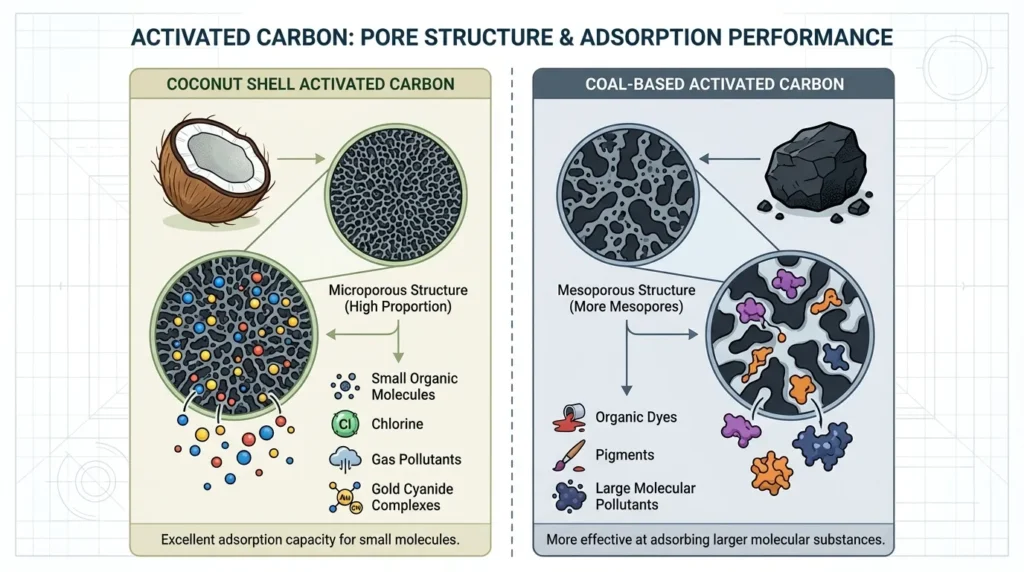
The pore structure is a key factor that determines the adsorption performance of activated carbon.
Coconut Shell Activated Carbon:
Coconut shell activated carbon mainly contains micropores, with a high proportion of microporous structures. Therefore, it has excellent adsorption capacity for small molecules.
Suitable for adsorbing:
- Small organic molecules
- Chlorine
- Gas pollutants
- Gold cyanide complexes
Coal-Based Activated Carbon:
Coal-based activated carbon typically contains more mesopores, which makes it more effective at adsorbing larger molecular substances.
Suitable for adsorbing:
- Organic dyes
- Pigments
- Large molecular pollutants
Mechanical Strength and Abrasion Resistance
Mechanical strength is an important factor that affects the service life of activated carbon.
Coconut Shell Activated Carbon:
Coconut shell carbon has a dense structure and high hardness, which makes it less likely to break during operation.
Advantages:
- Strong abrasion resistance
- Low attrition rate
- Long service life
For this reason, coconut shell activated carbon is often the preferred material in high-intensity operating environments such as gold recovery processes (CIP/CIL).
Coal-Based Activated Carbon:
The mechanical strength of coal-based activated carbon depends largely on the manufacturing process. Generally speaking, coal-based pellet (extruded) activated carbon has good mechanical strength, while some granular coal-based carbons may generate fines under certain operating conditions.
Contact me todayComparison of Adsorption Performance
In terms of adsorption performance, both types of activated carbon have their own advantages.
Coconut shell activated carbon:
- Typically has a higher iodine value
- Highly developed micropores
- Suitable for deep purification applications
Coal-based activated carbon:
- Rich mesoporous structure
- Stronger adsorption capacity for larger molecules
- Suitable for industrial wastewater treatment
Therefore, the choice often depends on the specific application scenario.
Typical Application Fields
Activated carbon produced from different raw materials has different pore structures and adsorption characteristics, which leads to different application focuses in practice. Coconut shell activated carbon is typically used in high-purity and high-performance applications, while coal-based activated carbon is widely used in large-scale industrial treatment processes.
Common Applications of Coconut Shell Activated Carbon:
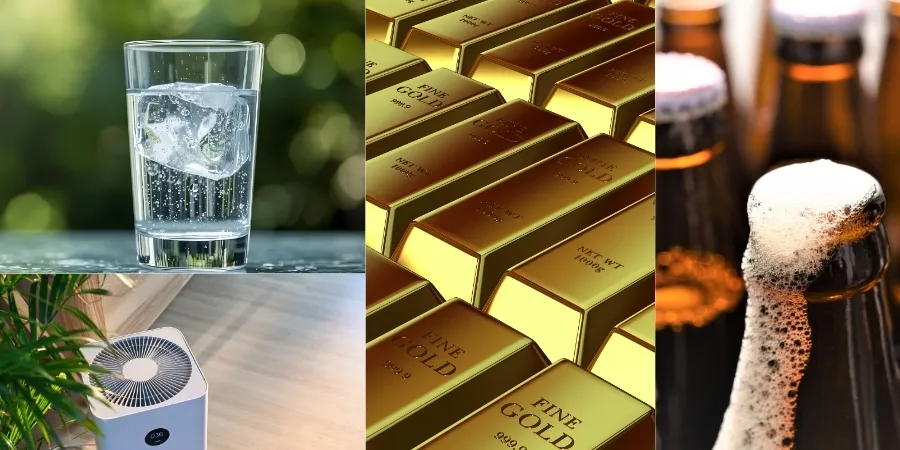
- Drinking water purification
- Gold recovery
- Air purification
- Advanced water treatment
- Food and beverage processing
Common Applications of Coal-Based Activated Carbon:

- Industrial wastewater treatment
- Flue gas treatment
- VOCs removal
- Solvent recovery
- Desulfurization and Denitrification
Cost Factors
From a pricing perspective, there are also differences between the two.
- Coconut shell activated carbon: Higher price, but stable performance and longer service life
- Coal-based activated carbon: Lower cost, suitable for large-scale industrial applications
Therefore, in practical procurement, it is important to find a balance between performance and cost.
How to Choose the Right Activated Carbon?
When selecting activated carbon, it is recommended to consider the following factors:
- Type of contaminants
- Molecular size
- Treatment process
- Operating conditions
- Budget considerations
If the target pollutants are small molecules and high adsorption efficiency and stability are required, coconut shell activated carbon is usually the preferred choice. If the application involves industrial wastewater or large organic molecules, coal-based activated carbon often offers better cost efficiency.
Conclusion
Coconut shell activated carbon and coal-based activated carbon each have their own advantages, and neither can be considered absolutely “better.” The most important factor is selecting the type of activated carbon that best matches the specific application requirements.
Contact us today to find the best activated carbon solution for your application.