
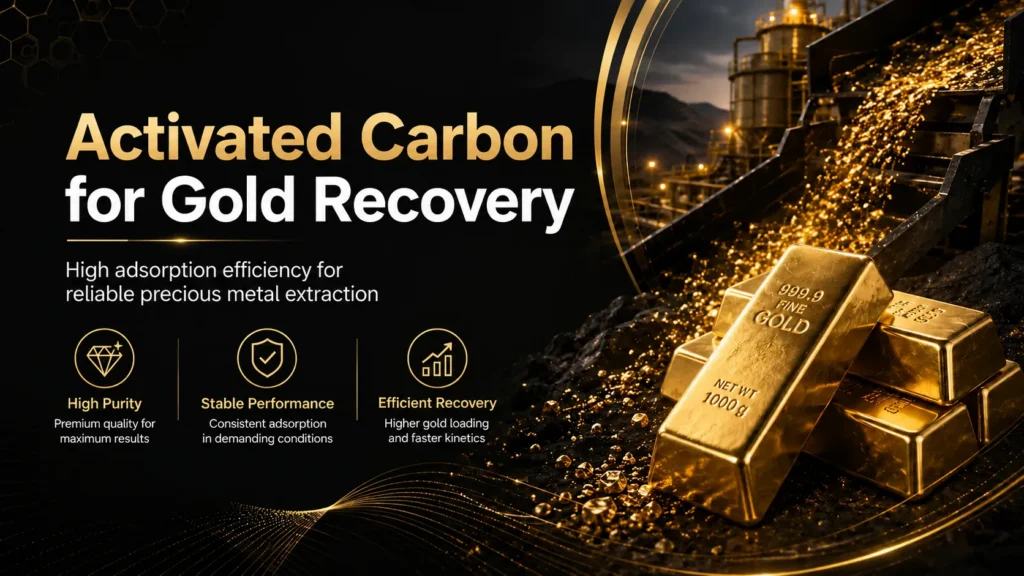
Gold recovery from ore is one of the most demanding and high-value applications of activated carbon in the mining industry. Since the 1970s, activated carbon has progressively replaced traditional zinc cementation as the preferred adsorbent for extracting gold from cyanide leach solutions. Today, the Carbon-in-Pulp (CIP), Carbon-in-Leach (CIL), and Carbon-in-Column (CIC) processes account for the majority of gold production worldwide, with activated carbon at the heart of each process.
This article explains how activated carbon works in gold recovery, the key process types, selection criteria for mining-grade carbon, and best practices for maximizing gold adsorption efficiency.
How Activated Carbon Adsorbs Gold
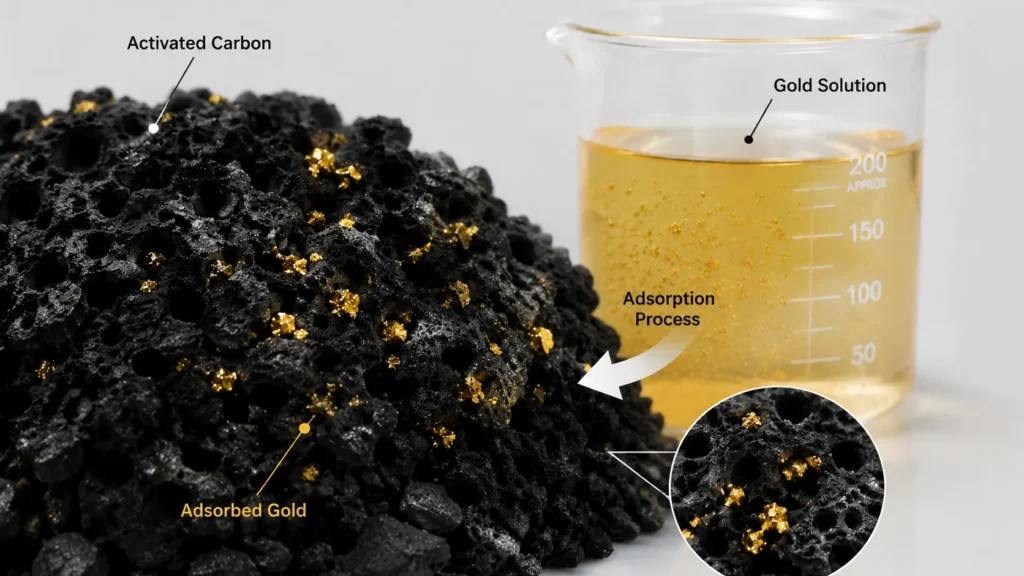
In gold mining, ore is first crushed and ground, then leached with a dilute cyanide solution (typically sodium cyanide, NaCN) to dissolve the gold and silver. The resulting solution contains the gold-cyanide complex:
Au + 2CN⁻ → [Au(CN)₂]⁻
Activated carbon adsorbs this gold-cyanide anion (aurocyanide) onto its surface through a combination of mechanisms:
- Ion-pair adsorption — The negatively charged aurocyanide ion pairs with cations (such as Ca²⁺) and is adsorbed at specific surface sites on the carbon.
- Physical adsorption — Van der Waals forces attract aurocyanide to the extensive internal surface area of the carbon’s micropore network.
- Electrochemical interaction — The carbon surface acts as a mild reducing agent, facilitating the reduction and deposition of gold.
Its high surface area (typically 950–1200m²/g ), well-developed microporous structure, and excellent hardness make coconut shell activated carbon the preferred adsorbent for gold recovery.
Contact me todayKey Process in Gold Recovery
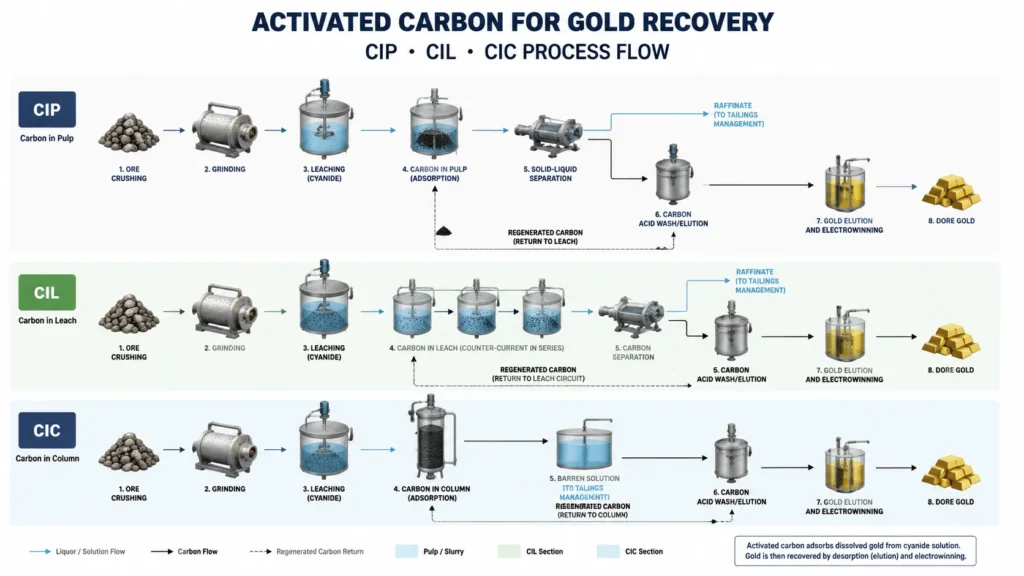
In the modern gold extraction industry, the most common gold recovery processes include CIP (carbon-in-pulp), CIL (carbon-in-leach), and CIC (carbon-in-column).
Carbon-in-Pulp (CIP)
In the CIP process, leaching and carbon adsorption occur in separate stages. The ore slurry is first fully leached in dedicated tanks to dissolve gold into solution. The gold-bearing solution is then transferred to a series of adsorption tanks, where activated carbon granules are added in a countercurrent flow arrangement.
Key features of CIP:
- Leaching and adsorption are carried out separately
- Typically used for oxide ores with fast leach kinetics
- High gold recovery rate
- Minimal wear on activated carbon
- Suitable for processing medium- to high-grade gold ore
Carbon-in-Leach (CIL)
The CIL process combines leaching and adsorption in the same tank simultaneously. Activated carbon is present in the leaching slurry, adsorbing gold as soon as it is dissolved from the ore. This is particularly effective when the ore contains preg-robbing minerals (natural carbonaceous material that would otherwise compete for gold adsorption).
Key features of CIL:
- Simultaneous leaching and adsorption reduce gold losses to preg-robbing material
- Faster overall processing time compared to CIP
- Shorter processing times
- Suitable for oxidised gold ore and low-grade gold ore
Carbon-in-Column (CIC)
In the CIC process, clarified gold-bearing solutions (free of solids) are passed through fixed columns packed with granular activated carbon. This method is widely used for heap leach operations, where gold is leached by dripping cyanide solution through crushed ore piled on lined pads.
Key features of CIC:
- Handles clarified solution only — no solids in the feed
- Commonly used in heap leach and vat leach operations
- Low activated carbon consumption
- Commonly used in heap leaching for gold extraction, tailings recovery
Elution and Gold Recovery from Loaded Carbon
Once the activated carbon is loaded with gold, the gold must be stripped (eluted) from the carbon before it can be refined into bullion. The most common elution methods are:
AARL (Anglo American Research Laboratories) Method
Hot caustic cyanide solution (90–110°C) is used to strip gold from the carbon in a two-stage process: a pre-soak followed by hot elution. This is one of the most widely used methods globally, producing a high-grade eluate suitable for electrowinning.
Zadra Process
A continuous elution method using hot caustic cyanide solution at atmospheric pressure. Simpler than AARL but requires longer elution times (24–48 hours). Commonly used in smaller operations.
Pressure Zadra Process
An accelerated version of the Zadra process operating under elevated pressure (200–500 kPa) and temperature (130–150°C), reducing elution time to 6–12 hours.
After elution, the gold-bearing eluate is processed by electrowinning, where gold is plated onto steel wool cathodes, then smelted into doré bars for further refining.
Carbon Regeneration
After elution, the stripped carbon must be thermally regenerated before reuse. Regeneration is carried out in a rotary kiln at temperatures of 650–750°C in a slightly oxidizing atmosphere. This process:
- Burns off organic fouling materials (oils, organic reagents, fine ore particles)
- Restores the carbon’s activity and adsorption capacity
- Removes calcium scaling and other inorganic deposits
Properly regenerated carbon typically recovers 90–98% of its original activity. Carbon attrition (physical degradation) during handling and regeneration causes a loss of approximately 1–2% per cycle, requiring periodic makeup additions of fresh carbon.
Contact me todayKey Selection Criteria for Gold Recovery Activated Carbon
| Parameter | Typical Specification | Why It Matters |
|---|---|---|
| Iodine Number | 950–1200 mg/g | Indicates total surface area and micropore development |
| Hardness / Abrasion Resistance | ≥98% | High hardness reduces carbon losses due to attrition during agitation |
| Particle Size | 6×12 mesh, 8×16 mesh | Optimal size for CIP/CIL tanks — balances screen retention and contact efficiency |
| Moisture Content | <5% | Affects handling, dosing accuracy, and initial adsorption rate |
| Ash Content | <3% | Lower ash means fewer inorganic impurities affecting adsorption sites |
Why Is Coconut Shell Activated Carbon Used for Gold Recovery?
In the gold recovery industry, especially in CIP, CIL, and CIC processes, coconut shell activated carbon is the most widely used type of activated carbon for gold recovery. It offers the following advantages:
Developed Microporous Structure
Coconut shell activated carbon has a highly developed microporous structure. After cyanide leaching, gold forms small gold-cyanide complex ions, which are ideally suited to enter the micropores of coconut shell activated carbon and be effectively adsorbed.
High Mechanical Strength and Excellent Wear Resistance
In CIP/CIL processes, activated carbon continuously moves and mixes with the slurry.
If the activated carbon lacks sufficient strength, it can easily lead to:
- Breakage
- Pulverization
- Carbon loss
- Increased carbon consumption
Coconut shell activated carbon features high hardness and excellent abrasion resistance, making it highly suitable for these demanding operating conditions.
Low Ash Content and Fewer Impurities
Activated carbon with high ash content may reduce gold adsorption efficiency, introduce impurities, and negatively affect elution and electrolysis performance. Coconut shell activated carbon naturally has low ash content, which provides several benefits:
- More stable adsorption
- Higher gold purity
- Better elution efficiency
- Less contamination to the system
Easy Elution and Regeneration
During the gold recovery process, loaded activated carbon must undergo elution and thermal regeneration for repeated use.
Coconut shell activated carbon demonstrates excellent stability under high temperatures:
- High elution efficiency
- Multiple regeneration cycles possible
- Good adsorption performance after regeneration
- Reduced overall operating costs
High Gold Adsorption Capacity
Coconut shell activated carbon typically features a high iodine value, large surface area, and well-developed microporous structure. These characteristics enable it to adsorb more gold.
- Improved production efficiency
- High gold loading capacity
- Reduced activated carbon consumption
Conclusion
In the modern gold extraction industry, as demands for higher recovery rates and greater cost-effectiveness continue to rise, coconut shell activated carbon has become an indispensable key adsorbent material in gold recovery systems, thanks to its stability and high efficiency.
Contact us today to obtain high-quality coconut shell activated carbon and free samples for testing.