

Color is one of the first qualities a wine drinker notices. For red wines, the deep ruby or garnet hue signals body and age; for whites, clarity and a pale straw color suggest freshness. But achieving the right color profile is not always easy. Variations in grape variety, harvest conditions, fermentation parameters, and oxidation exposure can all produce wines with off-shades—too dark, too brown, too yellow, or simply inconsistent from batch to batch.
Thanks to its excellent adsorption properties, activated carbon is a well-established method for correcting wine colour. This article will explain the role of activated carbon in wine decolourisation, helping you to select the appropriate activated carbon product to achieve the best decolourisation results.
How Activated Carbon Decolorizes Wine
Activated carbon removes color from wine through adsorption. The carbon’s highly porous structure provides a large internal surface area (800–1,300 m²/g) onto which pigment molecules—primarily anthocyanins, tannins, and other polyphenolic compounds—attach and are held by weak physical forces (van der Waals interactions). When powdered activated carbon is mixed into wine, these colored compounds migrate from the liquid onto the carbon surface. Once the carbon is removed by filtration, the color goes with it.
The effectiveness of the treatment depends on the carbon’s pore structure. Large pigment molecules require well-developed mesopores (2–50 nm) for effective adsorption. The micropores in activated carbon are better suited to removing low-molecular-weight odours and unpleasant smells.
Advantages of Activated Carbon for Wine Decolorization
Compared with alternative methods such as fining agents (bentonite, PVPP, gelatin) or blending, activated carbon offers several practical advantages for color correction:
- Predictable results – Decolorization follows a dose-response curve. A small laboratory trial before production tells you exactly how much carbon to use.
- Rapid action – Contact times of 15–30 minutes are typically sufficient. The treatment can be completed within a single tank turnaround.
- No permanent additives – The carbon is removed entirely by filtration. Nothing remains in the finished wine.
- Broad effectiveness – Works on anthocyanins (red pigments), oxidized brown compounds, and yellowing polyphenols in a single pass.
- Cost effective – Low dosage rates (5–60 g per hectoliter) mean the treatment cost per bottle is minimal.
- Food-grade safety – Products manufactured to food additive standards contain no harmful leachables.
Choosing the Right Activated Carbon for Wine Decolorization
Selecting the right activated carbon is crucial for effective decolourisation. TingyuanCarbon offers the following high-quality activated carbons for wine decolourisation:
Wood Powdered Activated Carbon
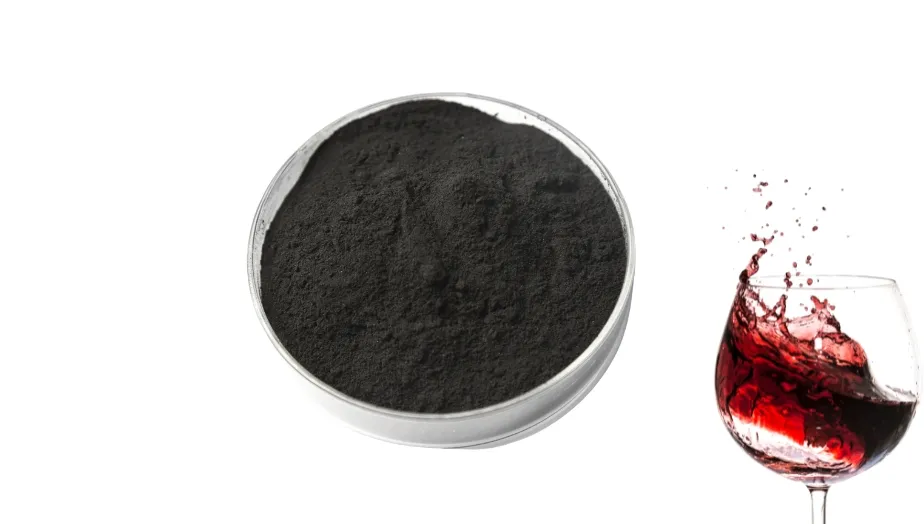
Due to its well-developed mesopore structure, wood-based activated carbon has excellent adsorption capacity for large pigment molecules, organic impurities, and oxidation by-products in wine. It is widely used in the food and beverage industry.
Main Features:
- Strong decolorization ability
- Well-developed mesoporous structure
- Fast adsorption rate
- Low ash content
- High food-grade safety
- Significantly improves wine clarity
Wood powdered activated carbon is especially suitable for removing:
- Browning pigments in wine
- Oxidized pigments
- Certain phenolic compounds
- Unwanted colors and suspended impurities
Coconut Shell Activated Carbon

Coconut shell activated carbon is produced from high-quality coconut shells and features a highly developed microporous structure and exceptional purity.
Compared with wood-based activated carbon, coconut shell activated carbon contains a richer micropore structure, making it more suitable for adsorbing small molecular impurities, odor-causing substances, and certain low-molecular-weight organic compounds. It plays an important role in the fine purification of wine.
Main Features:
- Highly developed microporous structure
- High adsorption precision
- Extremely low ash content
- Low impurity content
- High purity
- Excellent chemical stability
Coconut shell activated carbon typically contains lower levels of metallic impurities, making it more suitable for the food and beverage industry, where high-purity materials are required.
It is especially suitable for:
- Premium wine purification
- Distilled spirit purification
- Odor removal
- Fine filtration of alcoholic beverages
- Improving taste purity and overall flavor quality
Conclusion
For wine producers, selecting high-quality, stable food-grade activated carbon is a key factor in ensuring effective decolourisation and maintaining the quality of the wine.
We supply food-grade powdered wood-based and coconut shell activated carbon specifically designed for wine decolourisation. We supply our products to wineries and beverage producers worldwide. Contact us today for free samples and bespoke solutions.