
Gold mining is one of the most valuable industries in the world, and efficient gold recovery is vital in improving the economic benefits of mining. In modern gold extraction processes, activated carbon has become an essential key material due to its excellent adsorption properties, high mechanical strength, and good wear resistance.
Currently, activated carbon is widely used in processes such as Carbon-in-Pulp (CIP), Carbon-in-Leach (CIL), and Carbon-in-Column (CIC). These processes effectively adsorb gold-cyanide complexes from cyanide leach solutions, significantly improving gold recovery rates. This article will comprehensively explain the working principles, main applications, advantages of activated carbon in gold recovery, and how to choose the most suitable type for gold mines.
What is Activated Carbon for Gold Recovery?
Activated carbon for gold recovery is a high-performance granular carbon designed specifically for precious metal extraction. It is generally produced from high-quality coconut shells and offers the following features:
- Extremely high adsorption capacity for gold-cyanide complexes.
- High mechanical strength.
- Superior hardness.
- Uniform particle size.
- Low ash content.
- Long service life.
- Excellent regeneration properties.
Compared to regular activated carbon, gold recovery activated carbon is manufactured through special processes to endure extended operation in adsorption tanks while maintaining stable adsorption performance.
How Is Gold Recovered Using Activated Carbon?
Currently, the most common method for gold extraction is cyanide leaching. During the leaching process, gold reacts with cyanide and oxygen to form soluble gold cyanide complexes.
The simplified reaction equation is as follows:
4Au + 8NaCN + O₂ + 2H₂O → 4NaAu(CN)₂ + 4NaOH
Subsequently, activated carbon, relying on its highly porous structure, rapidly adsorbs the gold cyanide complexes from the solution onto its surface and into its pores.
Once the activated carbon reaches adsorption saturation, it proceeds to subsequent processes, including:
- Acid washing
- Desorption
- Electrolysis
- Smelting
After thermal regeneration, the activated carbon can be returned to the adsorption system for reuse. This recycling process not only improves gold recovery rates but also effectively reduces production costs.
Contact me todayMajor Processes Using Activated Carbon in Gold Recovery
There are three main processes for recovering gold using activated carbon:
Carbon-in-Pulp (CIP)
The CIP method is one of the most widely applied gold recovery processes.
Process Flow
Crushing → Grinding → Cyanidation → Activated Carbon Adsorption → Pulp Separation → Gold Desorption → Activated Carbon Regeneration
Advantages
- High gold recovery rate.
- Suitable for low-grade ores.
- Mature and stable process.
- Relatively low operating costs.
- Enables continuous production.
Carbon-in-Leach (CIL)
The CIL process combines leaching and adsorption simultaneously.
Activated carbon is added directly to the leach tank, allowing it to adsorb gold once the gold-cyanide complex forms.
Advantages
- Faster adsorption rate.
- Reduced cyanide consumption.
- Less gold loss.
- Simpler process flow.
- Higher production efficiency.
As a result, CIL is widely adopted in large-scale gold mines.
Carbon-in-Column (CIC)
The CIC process is mainly used for:
- Heap Leaching.
- Vat Leaching.
- Rich liquid treatment.
In this method, the gold-containing solution flows through columns filled with activated carbon, which adsorbs the gold.
Advantages:
- Simple operation.
- Low maintenance cost.
- Suitable for low-concentration gold solutions.
- Lower capital investment.
Why Coconut Shell Activated Carbon is Ideal for Gold Recovery
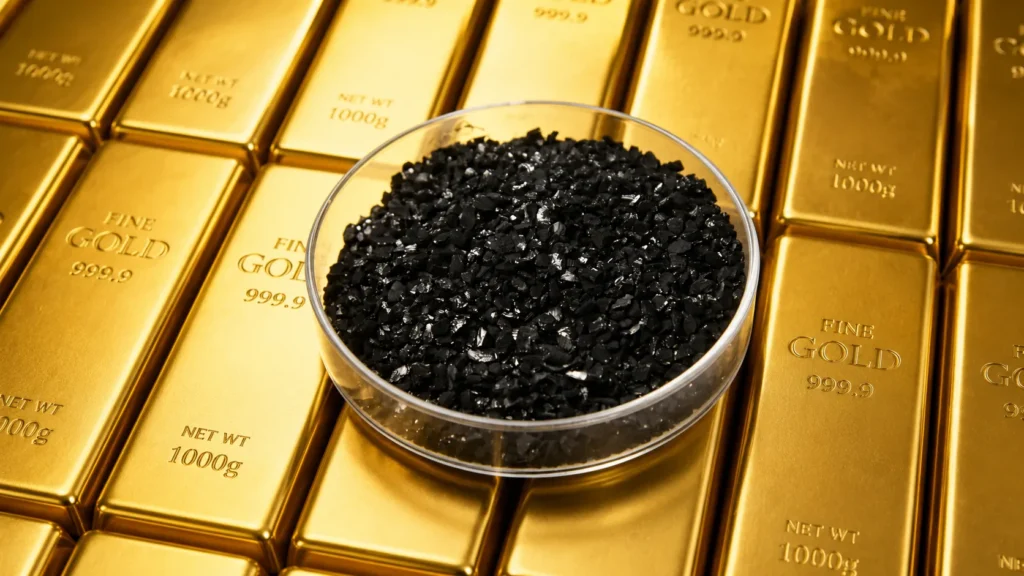
Thanks to its inherent advantages, coconut shell activated carbon has performed exceptionally well in gold recovery projects.
Developed Microporous Structure
Gold-cyanide complexes are small molecules, and the microporous structure of coconut shell carbon is ideal for adsorbing these complexes, resulting in superior gold adsorption efficiency.
High Hardness
In gold recovery operations, activated carbon undergoes continuous circulation through adsorption tanks. High hardness minimizes:
- Carbon breakage.
- Carbon loss.
- Creation of powdered carbon.
- Gold loss.
Top-quality activated carbon has a hardness exceeding 98%.
Low Ash Content
Low ash content ensures:
- Higher adsorption efficiency.
- Fewer impurities.
- Better regeneration results.
- Extended service life.
Premium coconut shell activated carbon typically has ash content controlled below 3%.
Excellent Wear Resistance
High-quality coconut shell activated carbon can withstand repeated:
- Screening
- Conveying
- Thermal regeneration
- Recycled use
Thereby significantly extending the service life of the activated carbon.
High Gold Loading Capacity
Premium activated carbon not only adsorbs gold rapidly but also has a high loading capacity for gold:
- Reducing usage levels.
- Lowering replacement costs.
- Increasing mining productivity.
Advantages of Using Activated Carbon in Gold Recovery
Employing activated carbon for gold recovery provides the following benefits:
- High gold recovery rate.
- Fast adsorption speed.
- Strong selectivity for gold-cyanide complexes.
- Low operational costs.
- Long service life.
- Reusable after multiple regeneration cycles.
- Stable adsorption performance.
- High mechanical strength.
- Low carbon loss rate.
- Environmentally friendly and promotes resource recycling.
- Ideal for industrial continuous production.
As a result, activated carbon is now the most widely used adsorbent material in gold mines worldwide.
Typical Specifications of Activated Carbon for Gold Recovery
| Parameter | Typical Value |
|---|---|
| Raw Material | Coconut Shell |
| Particle Size | 6×12 mesh, 8×16 mesh |
| Iodine Value | 950–1200 mg/g |
| Hardness | ≥98% |
| Ash Content | ≤3% |
| Moisture | ≤5% |
| Bulk Density | 480–520 g/L |
| CTC Adsorption | 55–65% |
Specific parameters can be customized based on mining process requirements.
How to Choose the Right Activated Carbon for Gold Recovery?
Selecting activated carbon requires consideration of several key factors:
Ore Characteristics
Different ores demand different carbon properties. Consider:
- Gold grade.
- Silver content.
- Organic impurities.
- Clay content.
Process Type
Specific processes require specific properties of activated carbon:
- CIP Process: Demands high hardness and abrasion resistance.
- CIL Process: Requires fast adsorption speed.
- CIC Process: Needs uniform particle size and low pressure drop.
Mechanical Strength
Since activated carbon is used in continuous circulation, higher hardness means:
- Lower carbon loss.
- Reduced replacement frequency.
- Lower overall costs.
Regeneration Performance
High-quality activated carbon retains excellent adsorption capacity even after multiple thermal regeneration cycles, reducing long-term operational costs.
Why Choose Our Activated Carbon for Gold Recovery?
As a specialized activated carbon manufacturer, we supply high-quality activated carbon for gold recovery to mines worldwide. Our advantages include:
- Premium coconut shell raw material.
- Strong gold adsorption capability.
- Hardness up to 98% or more.
- Low ash content and low wear rate.
- Stable product quality.
- Strict quality control system.
- Customizable particle sizes and specifications.
- Direct factory supply at competitive prices.
- Fast global logistics delivery.
- Professional technical support.
Whether your project uses CIP, CIL, or CIC processes, we can provide the best activated carbon solutions tailored to your requirements.
Conclusion
Activated carbon, with its exceptional adsorption capacity, high mechanical strength, and excellent regeneration performance, has become an indispensable material in modern gold recovery processes. If you are seeking a reliable supplier for activated carbon in gold recovery, feel free to contact us.
We will provide high-performance, reliable activated carbon products and professional technical support tailored to your mining processes and production needs.
FAQs
Why is coconut shell activated carbon most commonly used for gold recovery?
Coconut shell activated carbon has a well-developed microporous structure, high hardness, low ash content, and excellent wear resistance, making it highly effective for adsorbing gold-cyanide complexes while minimizing carbon loss.
Why is the hardness of activated carbon so important?
In gold recovery, activated carbon undergoes continuous circulation. High hardness reduces particle breakage and powder generation, which improves gold recovery efficiency and reduces carbon loss.
Can activated carbon for gold recovery be reused?
Yes. Activated carbon can be reused after desorption and thermal regeneration, maintaining high adsorption performance and significantly reducing operating costs.
What are the common specifications of activated carbon for gold recovery?
Common specifications include 6×12 mesh and 8×16 mesh, but the final selection depends on mining processes and equipment requirements.
How long does activated carbon last in gold recovery applications?
Its lifespan depends on ore characteristics, the number of regeneration cycles, and operating conditions. High-quality coconut shell activated carbon typically maintains good performance through multiple adsorption-regeneration cycles.